
Distant Retrograde Orbit
Author: Tianjiang Says
Website: https://cislunarspace.cn
Definition
A Distant Retrograde Orbit (DRO) is a stable periodic orbit around the Moon in the Circular Restricted Three-Body Problem (CRTBP). In the synodic reference frame, a DRO moves in the opposite direction to the Moon's orbit around Earth, hence the term "retrograde" orbit.
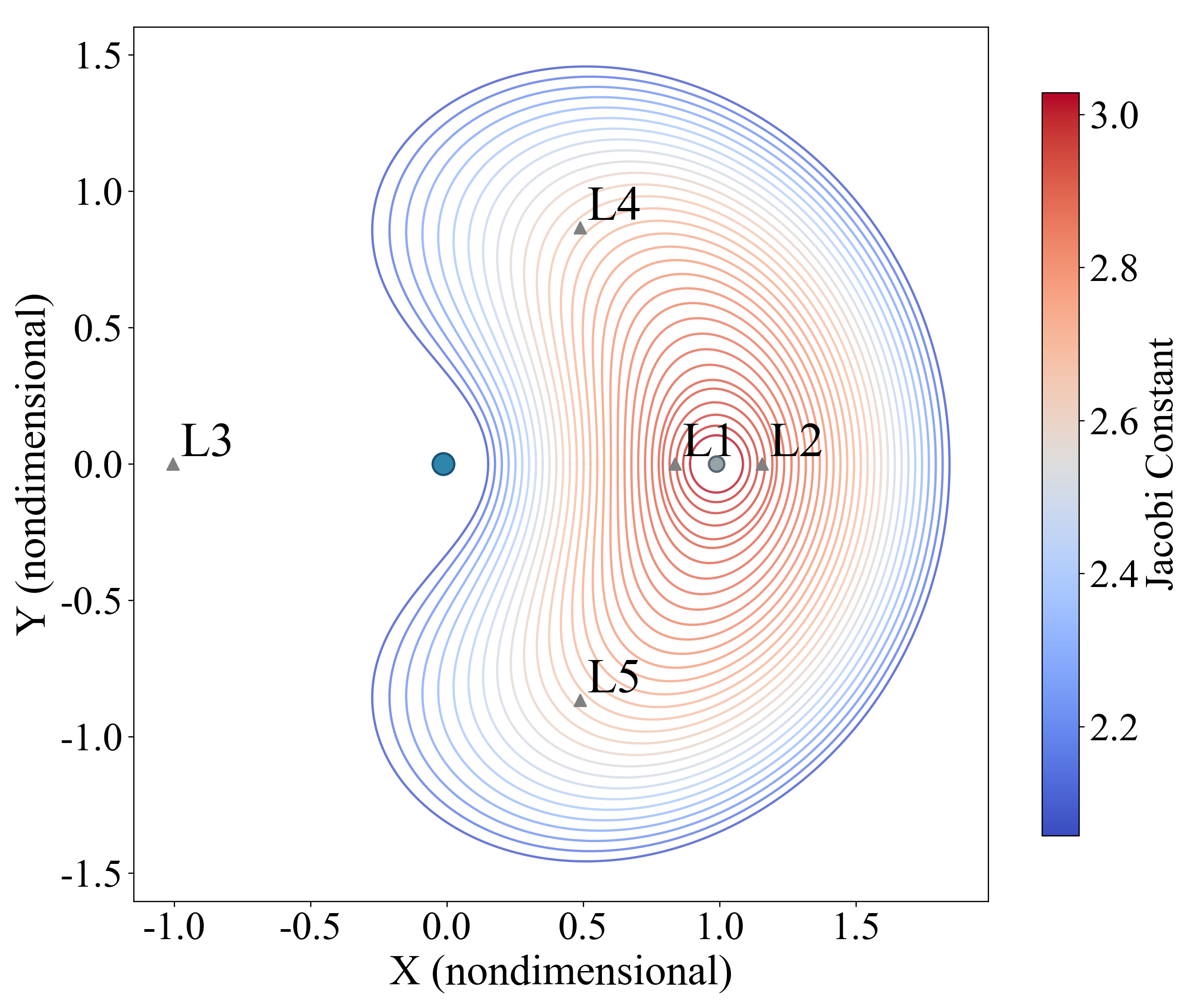 DRO orbit shape in the Earth-Moon synodic reference frame
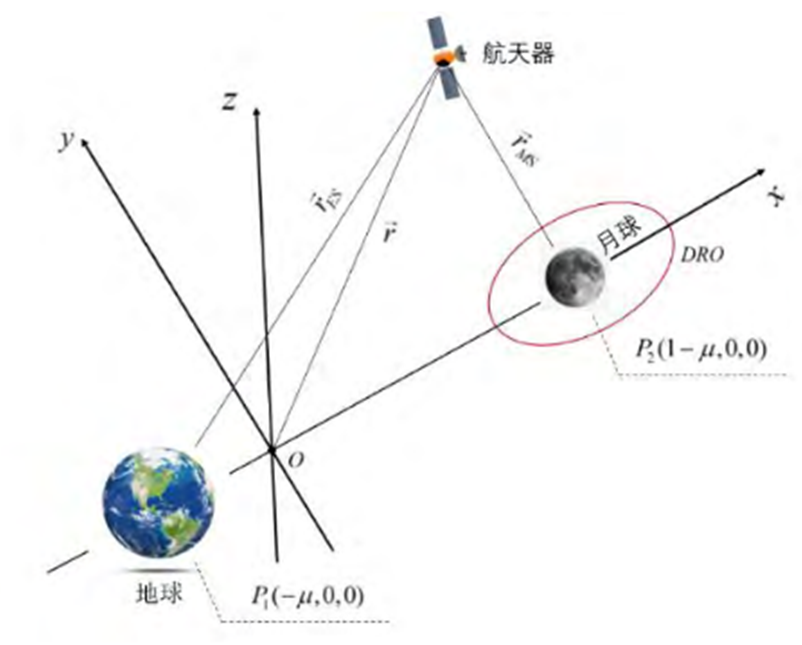 Geometric configuration of DRO in the barycentric rotating reference frame
Geometric Characteristics
In the synodic reference frame, a planar DRO appears as an approximately elliptical closed curve with the Moon as its geometric center. Its main parameters are:
- -direction amplitude : The distance from the intersection of the orbit with the Earth-Moon line to the Moon, which is the primary parameter describing the DRO configuration
- When is small, the DRO is close to the Moon, approximating a circular lunar orbit
- As increases, the DRO moves farther from the Moon, and the orbit shape evolves from nearly circular to an ellipse with significant eccentricity
- -direction amplitude : Introducing a -direction amplitude yields a three-dimensional non-planar DRO, which exhibits both retrograde motion within the plane and periodic oscillation in the direction
Resonance Relationships
DROs exhibit resonance relationships with the Moon's orbital period. When the DRO's orbital period and the Moon's orbital period satisfy (where and are positive integers), it is referred to as an resonant DRO.
| Resonance Ratio | Characteristics |
|---|---|
| 1:1, 2:1 (low-order resonance) | Closer to the Moon, with stronger stability |
| 3:1, 4:1 (high-order resonance) | Farther from the Moon, larger orbital amplitude, providing greater potential energy advantage for transfers to cislunar space |
For example, a 2:1 resonant DRO has an orbital period approximately half that of the Moon's orbital period -- meaning the spacecraft completes two orbits around the Moon for every one orbit the Moon completes around Earth.
Dynamic Symmetry
In the CRTBP, DROs exhibit dynamic symmetry about the -axis: when the orbit crosses the -axis, there is only a -direction velocity component , while the -direction position and the and direction velocities are all zero. This symmetry means that one only needs to select an initial point on the -axis, use and period as free variables, integrate for half a period, and verify whether the orbit returns to the -axis -- enabling iterative convergence to a closed periodic orbit.
Orbital Parameter Characteristics
For the Earth-Moon system, the main parameter ranges of the DRO family (based on the dynamic catalog statistics by Guzzetti et al.) are as follows:
| Parameter | Range |
|---|---|
| Jacobi constant | 1.4352 – 3.0180 (mean 2.1184) |
| Orbital period | 5.87 – 27.38 days (mean 24.63 days) |
| Stability index | 1.0000 – 1.0002 (mean 1.0001) |
The stability index of DROs is extremely close to 1.0, indicating that this orbit family possesses exceptional long-term stability and is one of the very few naturally stable periodic orbits in cislunar space.
Behavior in Ephemeris Models
In perturbative environments such as ephemeris models, where celestial body positions change over time, DROs no longer maintain strict periodicity and evolve into quasi-periodic orbits that wind within a limited region. Their trajectories do not close, but the overall shape remains stable.
Operational Cost Analysis
Orbit Insertion from LEO
Departing from a 300 km altitude LEO, typical transfer schemes to DRO include:
- Direct two-impulse transfer: Consisting of only two impulsive maneuvers — one departing from LEO and one inserting into DRO. The direct transfer flight time is approximately 5.4 – 7.2 days.
- Lunar gravity-assist three-impulse transfer: An additional midcourse maneuver is added at a 200 km lunar pericenter altitude, leveraging lunar gravity to reduce the total ΔV cost.
Studies by Guzzetti et al. have shown that DRO direct insertion ΔV (ΔV_POI) is among the lowest of all libration point orbits and lunar-centered orbits, averaging on the order of hundreds of m/s. This makes DRO one of the most accessible cislunar orbits from LEO.
Station-Keeping Cost
DRO station-keeping costs are extremely low:
- Long-term station-keeping strategy assessments based on Monte Carlo simulations show that DRO annual average ΔV requirements are only on the order of a few m/s.
- Station-keeping maneuvers are typically executed at or near x-axis crossings, where implementation is operationally convenient and costs approach the global optimum.
- The exceptional stability of DROs means that even with initial state errors (1 km position, 1 cm/s velocity standard deviation) and maneuver execution errors (1% standard deviation), the orbit maintains good characteristics over extended periods.
Application Value
With excellent long-term stability (requiring no or only minimal orbital maneuvers to maintain) and advantageous orbital position, DROs have become the preferred mission orbit for cislunar space infrastructure. Application scenarios include:
- Situation awareness constellation deployment
- Cislunar space navigation system networking
- Deep space relay communications
- Material storage and strategic station-keeping
NASA's Lunar Reconnaissance Orbiter (LRO) mission has validated the application value of DROs in lunar exploration. Recent research has shown that non-planar DROs with -direction amplitude can avoid solar eclipses, further improving observer effectiveness.
In the dynamic catalog framework proposed by Guzzetti et al., DROs are listed as preferred candidate orbits for long-term space infrastructure near the Moon. Key advantages include:
- Favorable geometric configuration: Close to the Moon, facilitating lunar surface operations and communications
- Low maintenance cost: Exceptional stability minimizes station-keeping budget
- Low insertion cost: Direct transfer ΔV from LEO is relatively low
- Accessibility: Moderate flight time (~5.4 – 7.2 days), suitable for crewed missions
Application in A2PPO Low-Thrust Transfer Research
Ul Haq et al. (2026) used the A2PPO (Attention-Augmented Proximal Policy Optimization) algorithm to investigate autonomous low-thrust transfers from L₂ NRHO to lunar DRO (Scenario S3):
- Departure orbit: L₂ southern NRHO (, period 6.99 days)
- Target orbit: Lunar DRO (, period 6.95 days)
- Transfer result: 7.60 days, consuming 5.10 kg of propellant
- Transfer characteristics: Forms a lunar gravity-assist structure; the orbit gradually transitions from prograde to retrograde
Transfers between NRHO and DRO represent a challenging problem in low-thrust trajectory optimization: the two orbits lie in different dynamical corridors with no simple manifold connection paths. Without requiring an initial guess, A2PPO autonomously learned a transfer trajectory that closely matches the direct collocation method result (7.63 days / 5.11 kg).
Related Concepts
- Near-Rectilinear Halo Orbit (NRHO)
- Earth-Moon L1/L2 Halo Orbits (EML1/EML2 Halo)
- Distant Prograde Orbit (DPO)
- Low Prograde Orbit (LoPO)
- Circular Restricted Three-Body Problem (CR3BP)
- Ephemeris Model
- A2PPO (Attention-Augmented Proximal Policy Optimization)
- Starshade
- Birkhoff-Gustavson Normal Form
- Poincaré Section
- Resonance orbit
- Quasi-periodic orbit
Core Elements
Orbital Definition
Distant Retrograde Orbit (DRO) is a stable periodic orbit around the Moon in the CRTBP, moving in the opposite direction to the Moon's orbit around Earth in the synodic reference frame. Key parameters include the x-direction amplitude (describing orbit configuration) and z-direction amplitude (enabling three-dimensional non-planar DROs).
Dynamic Characteristics
- Long-term stability: Requires no or only minimal orbital maneuvers to maintain
- Resonance relationships: Exhibits 1:1, 2:1, 3:1, etc. resonance ratios with the Moon's orbital period
- Dynamic symmetry: Symmetric about the x-axis; when crossing the x-axis, only the y-direction velocity component exists
- Ephemeris model behavior: Evolves into quasi-periodic orbits winding within a limited region
Design Methods
- Initial condition acquisition: Exploit dynamic symmetry by selecting initial points on the x-axis, using and period as free variables for iterative convergence
- Continuation method: Continuation from 1:1 resonant small-amplitude DRO to higher-order resonant large-amplitude DRO
- Ephemeris model conversion: Transfer CR3BP orbits to ephemeris models via the two-level differential correction method
References
- Whitley R, Martinez R. Options for staging orbits in cislunar space[C]. 2016.
- Broucke R. Periodic orbits in the restricted three-body problem with Earth-Moon masses[R]. 1968.
- Chen Yuju. DRO Orbit Design and Control Research for Cislunar Space Situation Awareness[D]. 2024.
- Genszler G, Savransky D, Soto G J. Surveying orbits in cislunar space for telescope-starshade observatories[J]. 2026.
- Qiao C, Long X, Yang L, et al. Orbital parameter characterization and objects cataloging for Earth-Moon collinear libration points[J]. Chinese Journal of Aeronautics, 2025. doi: 10.1016/j.cja.2025.103869.
- Ul Haq I U, Dai H, Du C. Autonomous low-thrust trajectory optimization in cislunar space via attention-augmented reinforcement learning[J]. Aerospace Science and Technology, 2026.
- Guzzetti D, Bosanac N, Howell K C. A framework for efficient trajectory comparisons in the Earth-Moon design space[C]. AAS/AIAA Space Flight Mechanics Meeting, 2014.
- Folta D, Bosanac N, Guzzetti D, et al. An Earth-Moon system trajectory design reference catalog[C]. 2nd IAA Conference on Dynamics and Control of Space Systems, 2014.