
Cislunar Space Beginner's GuideCislunar Space Beginner's Guide
  • Satellite Orbit Simulation
  • Historical Inquiry
Cislunar Glossary
Resources & Tools
Blue Team Research
Space News
AI Q&A
Forum
Home
Gitee
GitHub
  • 简体中文
  • English
  • Satellite Orbit Simulation
  • Historical Inquiry
Cislunar Glossary
Resources & Tools
Blue Team Research
Space News
AI Q&A
Forum
Home
Gitee
GitHub
  • 简体中文
  • English
  • Site map

    • Home (overview)
    • Intro · what is cislunar space
    • Orbits · spacecraft trajectories
    • Frontiers · directions & labs
    • Glossary · terms & definitions
    • Tools · data & code
    • News · space industry archive
    • Topic · blue-team research
  • Cislunar glossary (terms & definitions)

    • Cislunar Space Glossary
    • Fundamentals

      • Allan Deviation (ADEV)
      • Dual One-Way Ranging (DOWR)
      • Einstein Equivalence Principle (EEP)
      • Gravitational Redshift
      • High Altitude Airship (HAA)
      • Near-space
      • Passive Hydrogen Maser (PHM)
      • Stratospheric Airship
      • /en/glossary/fundamentals/absolute-range/
      • /en/glossary/fundamentals/aerodynamic-coefficient/
      • /en/glossary/fundamentals/aerodynamic-moment/
      • /en/glossary/fundamentals/aerospace-vehicle/
      • /en/glossary/fundamentals/ballistic-coefficient/
      • /en/glossary/fundamentals/bi-elliptic-transfer/
      • /en/glossary/fundamentals/body-frame/
      • /en/glossary/fundamentals/celestial-coordinate-system/
      • /en/glossary/fundamentals/celestial-sphere/
      • /en/glossary/fundamentals/characteristic-velocity/
      • /en/glossary/fundamentals/coverage-angle/
      • /en/glossary/fundamentals/earth-ellipsoid/
      • /en/glossary/fundamentals/earth-oblateness-perturbation/
      • /en/glossary/fundamentals/ecef-frame/
      • /en/glossary/fundamentals/energy-parameter/
      • /en/glossary/fundamentals/finite-thrust-maneuver/
      • /en/glossary/fundamentals/free-flight-phase/
      • /en/glossary/fundamentals/free-flight-trajectory/
      • /en/glossary/fundamentals/frozen-orbit/
      • /en/glossary/fundamentals/gaussian-perturbation-equations/
      • /en/glossary/fundamentals/geocentric-inertial-frame/
      • /en/glossary/fundamentals/gps-time/
      • /en/glossary/fundamentals/gravitational-potential/
      • /en/glossary/fundamentals/gravity-turn/
      • /en/glossary/fundamentals/gravity-vs-gravitation/
      • /en/glossary/fundamentals/hit-equation/
      • /en/glossary/fundamentals/hohmann-transfer/
      • /en/glossary/fundamentals/inertial-navigation-system/
      • /en/glossary/fundamentals/instantaneous-balance/
      • /en/glossary/fundamentals/isru/
      • /en/glossary/fundamentals/julian-date/
      • /en/glossary/fundamentals/kepler-equation/
      • /en/glossary/fundamentals/kompsat/
      • /en/glossary/fundamentals/lagrangian-perturbation-equations/
      • /en/glossary/fundamentals/launch-azimuth/
      • /en/glossary/fundamentals/launch-window/
      • /en/glossary/fundamentals/lift-to-drag-ratio/
      • /en/glossary/fundamentals/load-factor/
      • /en/glossary/fundamentals/longitudinal-lateral-motion/
      • /en/glossary/fundamentals/lunar-lander/
      • /en/glossary/fundamentals/minimum-energy-trajectory/
      • /en/glossary/fundamentals/newton-iteration-method/
      • /en/glossary/fundamentals/nutation/
      • /en/glossary/fundamentals/optimal-velocity-inclination/
      • /en/glossary/fundamentals/orbit-capture/
      • /en/glossary/fundamentals/orbit-insertion-conditions/
      • /en/glossary/fundamentals/orbital-elements/
      • /en/glossary/fundamentals/orbital-equation/
      • /en/glossary/fundamentals/orbital-maneuver/
      • /en/glossary/fundamentals/orbital-phase/
      • /en/glossary/fundamentals/orbital-transfer-vehicle/
      • /en/glossary/fundamentals/perturbation-motion/
      • /en/glossary/fundamentals/phasing-orbit/
      • /en/glossary/fundamentals/pitch-program/
      • /en/glossary/fundamentals/powered-phase/
      • /en/glossary/fundamentals/precession/
      • /en/glossary/fundamentals/pressure-center/
      • /en/glossary/fundamentals/range-error-coefficient/
      • /en/glossary/fundamentals/reentry-corridor/
      • /en/glossary/fundamentals/reentry-phase/
      • /en/glossary/fundamentals/repeat-ground-track-orbit/
      • /en/glossary/fundamentals/reusable-launch-vehicle/
      • /en/glossary/fundamentals/satellite-ring/
      • /en/glossary/fundamentals/sequential-quadratic-programming/
      • /en/glossary/fundamentals/skip-reentry/
      • /en/glossary/fundamentals/solar-exposure-factor/
      • /en/glossary/fundamentals/specific-angular-momentum/
      • /en/glossary/fundamentals/specific-impulse/
      • /en/glossary/fundamentals/stagnation-heat-flux/
      • /en/glossary/fundamentals/standard-atmosphere/
      • /en/glossary/fundamentals/subsatellite-track/
      • /en/glossary/fundamentals/sun-synchronous-orbit/
      • /en/glossary/fundamentals/thrust-to-weight-ratio/
      • /en/glossary/fundamentals/thrust/
      • /en/glossary/fundamentals/total-angle-of-attack/
      • /en/glossary/fundamentals/trajectory-equation/
      • /en/glossary/fundamentals/trajectory-optimization/
      • /en/glossary/fundamentals/trim-angle-of-attack/
      • /en/glossary/fundamentals/true-anomaly/
      • /en/glossary/fundamentals/tsiolkovsky-equation/
      • /en/glossary/fundamentals/turning-program/
      • /en/glossary/fundamentals/two-body-problem/
      • /en/glossary/fundamentals/utc/
      • /en/glossary/fundamentals/variation-of-parameters/
      • /en/glossary/fundamentals/velocity-frame/
      • /en/glossary/fundamentals/velocity-inclination-angle/
      • /en/glossary/fundamentals/vis-viva-equation/
      • /en/glossary/fundamentals/vleo/
      • /en/glossary/fundamentals/walker-constellation/
      • /en/glossary/fundamentals/zero-angle-of-attack-reentry/
    • Dynamics & Math

      • A* Search Algorithm (A* Search)
      • A2PPO (Attention-Augmented Proximal Policy Optimization)
      • Action-Angle Variables
      • Backstepping Sliding Mode Control
      • Backward Stability Set
      • Bang-bang Control (Bang-bang Control)
      • Barycentric Synodic Coordinate System
      • Batch Deployment (Batch Deployment)
      • Bicircular Four-Body Problem
      • Birkhoff-Gustavson Normal Form
      • Buoyancy-weight Imbalance
      • Capture Set
      • Central Manifold
      • Chaos Effect
      • Clohessy-Wiltshire (CW) Equation
      • Co-state Normalization (Co-state Normalization)
      • Coasting Arc (Coasting Arc)
      • Continuation Method (Parameter Continuation)
      • Continuation (延拓)
      • Cooperative Agent (CA)
      • CR3BP with Low-Thrust (CR3BP-LT)
      • Circular Restricted Three-Body Problem (CR3BP)
      • Curriculum Learning
      • Deep Reinforcement Learning
      • Differential Correction (微分修正)
      • Differential Evolution (DE) Algorithm
      • Differential Games (Differential Games)
      • Direct Collocation
      • Dynamic Programming (Dynamic Programming)
      • Dynamic Target Method
      • Ephemeris Model
      • Equinoctial Orbital Elements (Equinoctial Orbital Elements)
      • Fuzzy Backstepping Control
      • Generalized Advantage Estimation (GAE)
      • Gaussian Process Regression
      • Geocentric Rotating Coordinate System (GRC)
      • Heteroclinic Orbit Transfer (Heteroclinic Orbit Transfer)
      • Hill Three-Body Problem
      • Homotopy Method (Homotopy Method)
      • Improved Baseline Control-Point Method (Improved Baseline Control-Point Method)
      • Impulsive Maneuver (脉冲机动)
      • Initial Value Optimization
      • Invariant Manifold (Invariant Manifold)
      • J2000 Geocentric Equatorial Coordinate System (J2000 Geocentric Equatorial Coordinate System)
      • Jacobi Constant (Jacobi Integral)
      • K-Means Clustering (K-Means Clustering)
      • K-Medoids Clustering (K-Medoids Clustering)
      • KD-Tree (KD-Tree)
      • Libration Point (Equilibrium Point)
      • Libration Point Spacecraft Body Coordinate System (Libration Point Spacecraft Body Coordinate System)
      • Libration Point Spacecraft Orbital Coordinate System (Libration Point Spacecraft Orbital Coordinate System)
      • Lindstedt-Poincare Method (Lindstedt-Poincare Method)
      • L2-centered Rotating Coordinate System (L2-centered Rotating Coordinate System, LRC)
      • Low-Thrust Transfer MDP Formulation
      • Mass Discontinuity (Mass Discontinuity)
      • Monodromy Matrix
      • Newton-Euler Equations
      • Particle Swarm Optimization
      • Patch Point (Splicing Point)
      • Patched Method (拼接法)
      • Poincaré Map (庞加莱图)
      • Poincaré Section
      • Quasi-Bicircular Problem (QBCP)
      • Quasi-Bicircular Four-Body Problem
      • Regional Station-keeping Control
      • Seven-node Model
      • Shooting Method
      • Six-DOF Motion Equations
      • Sliding Mode Control
      • Solar Radiation Pressure (SRP)
      • Stability Index
      • Stability Set
      • State Transition Matrix (STM)
      • Static Lift
      • Strobe Map
      • Targeting Method
      • Thermo-mechanical Coupling Model
      • Thermodynamic Model
      • Two-Level Differential Correction Method
      • Two-node Model
      • Variational Mode Decomposition
      • Zero-Velocity Surface
      • /en/glossary/dynamics/ddpg/
      • /en/glossary/dynamics/hcpso/
      • /en/glossary/dynamics/mo-mcts/
      • /en/glossary/dynamics/nsga-ii/
      • /en/glossary/dynamics/pareto-optimal/
      • /en/glossary/dynamics/pontryagin-principle/
      • /en/glossary/dynamics/pseudo-arclength-continuation/
      • /en/glossary/dynamics/pursuit-evasion-game/
      • /en/glossary/dynamics/q-law/
      • /en/glossary/dynamics/reachable-set/
      • /en/glossary/dynamics/reduced-order-dynamics/
      • /en/glossary/dynamics/regularization/
      • /en/glossary/dynamics/rlepeso/
      • /en/glossary/dynamics/saddle-point-strategy/
      • /en/glossary/dynamics/state-dependent-tsp/
      • /en/glossary/dynamics/two-dominant-invariant-manifold/
      • /en/glossary/dynamics/zero-effort-miss/
    • Mission orbits

      • Apolune (远月点)
      • Ballistic Capture Orbit
      • Cycler Trajectory
      • DRO Constellation
      • Distant Retrograde Orbit (DRO)
      • Earth-Moon L1/L2 Halo Orbit (EML1/EML2 Halo)
      • Free-Return Trajectory (自由返回轨道)
      • Full Lunar Surface Coverage Orbit
      • Halo Orbit (Halo 轨道)
      • Lissajous Orbit (Lissajous 轨道)
      • Low-Energy Transfer Orbit
      • Lyapunov Orbit (Lyapunov 轨道)
      • Multi-Revolution Halo Orbit
      • Near-Rectilinear Halo Orbit (NRHO)
      • Orbit Identification
      • Orbit Keeping (Station-Keeping)
      • Parking Orbit (停泊轨道)
      • Perilune (近月点)
      • Prograde (顺行)
      • Quasi-Periodic Orbit
      • Resonance Orbit
      • Retrograde (逆行)
      • Transfer Orbit (转移轨道)
      • /en/glossary/orbits/axial-orbit/
      • /en/glossary/orbits/butterfly-orbit/
      • /en/glossary/orbits/dpo/
      • /en/glossary/orbits/horseshoe-orbit/
      • /en/glossary/orbits/hub-and-spoke/
      • /en/glossary/orbits/lopo/
      • /en/glossary/orbits/polynomial-constraint-stationkeeping/
      • /en/glossary/orbits/primary-impulse-transfer/
      • /en/glossary/orbits/vertical-orbit/
    • Navigation

      • Altitude Regulation
      • Cislunar Spatiotemporal Reference
      • Earth-Moon Hybrid Navigation
      • Earth GNSS Weak Signal Navigation
      • Inter-Satellite Link Navigation
      • LiAISON Navigation
      • LunaNet (Lunar Network)
      • Lunar Navigation Constellation
      • Moonlight Initiative
      • Tiandu-1
      • Trajectory Planning
      • X-ray Pulsar Navigation
      • /en/glossary/navigation/autonomous-navigation/
      • /en/glossary/navigation/extended-kalman-filter/
      • /en/glossary/navigation/gagan/
      • /en/glossary/navigation/irnss/
      • /en/glossary/navigation/observability/
      • /en/glossary/navigation/orbit-identification/
      • /en/glossary/navigation/pnt/
      • /en/glossary/navigation/sem-autonomous-navigation/
    • Lunar minerals

      • Changeite-Ce (Cerium Changeite)
      • Changeite-Mg (Magnesium Changeite)
    • Programs & missions

      • Artemis Program
      • LuGRE Experiment
    • Other

      • Actuator Error
      • Chain-of-Thought (CoT) Prompting
      • Cislunar Navigation Prospects
      • Cislunar Space (地月空间)
      • EXOSIMS
      • Floquet Mode Method
      • Impulse Thrust
      • Insertion Error
      • Low Earth Orbit / LEO (低地球轨道)
      • Low-Rank Adaptation (LoRA)
      • Lunar Gravity Assist / LGA (月球借力)
      • Navigation Error
      • Noncooperative Target
      • Nuclear Thermal Propulsion (NTP)
      • Orbit Insertion (入轨)
      • Period-Doubling Bifurcation
      • Longitudinal Coupling Vibration (POGO)
      • Powered Lunar Flyby / PLF (有动力月球借力)
      • Prompt Tuning (P-tuning)
      • Reflection Coefficient (C_R)
      • Solar Constant (S₀)
      • Space Traffic Management (STM)
      • Spacecraft Intention Recognition
      • Starshade
      • Weak Stability Boundary / WSB (弱稳定边界)
      • /en/glossary/other/gslv/
      • /en/glossary/other/insat/
      • /en/glossary/other/orbital-residence-platform/
      • /en/glossary/other/pslv/
      • /en/glossary/other/pursuit-evasion-defense/
    • Organizations

      • Anduril Industries
      • Booz Allen Hamilton
      • General Dynamics Mission Systems
      • GITAI USA
      • Lockheed Martin
      • Northrop Grumman
      • Quindar
      • Raytheon Missiles & Defense
      • Sci-Tec
      • SpaceX
      • True Anomaly
      • Turion Space
      • /en/glossary/organizations/danuri/
      • /en/glossary/organizations/isro/
      • /en/glossary/organizations/kasa/
      • /en/glossary/organizations/sriharikota/
      • /en/glossary/organizations/true-anomaly-company/
    • Military space doctrine

      • Cislunar Space Situational Awareness
      • Competitive Endurance
      • Component Field Commands
      • Commander, Space Forces (COMSPACEFOR)
      • Counterspace Operations
      • DOTMLPF-P Framework
      • Force Design
      • Force Development
      • Force Employment
      • Force Generation
      • Golden Dome
      • Mission Command
      • Mission Delta (MD)
      • Operational Test and Training Infrastructure (OTTI)
      • Resilient/Disaggregated Architecture
      • Space Domain Awareness (SDA)
      • Space Mission Task Force (SMTF)
      • Space Superiority
      • Space Force Generation Process (SPAFORGEN)
      • System Delta (SYD)
      • /en/glossary/doctrine/asat/
      • /en/glossary/doctrine/civil-military-integration/
      • /en/glossary/doctrine/directed-energy-weapon/
      • /en/glossary/doctrine/distributed-architecture/
      • /en/glossary/doctrine/kinetic-weapon/
      • /en/glossary/doctrine/persistent-detection-corridor/
      • /en/glossary/doctrine/resilience-map/
    • Observation techniques

      • Astrometry
      • Background Star Elimination
      • Cislunar Moving Objects
      • Continuous Coverage (CP)
      • Earth Albedo
      • Ephemeris Correlation
      • Hot Pixel
      • Image Registration
      • Image Stacking
      • Lunar Glare Zone
      • Quasi-zero Wind Layer
      • Segmentation Map
      • Shift-and-Add (SAA)
      • Sidereal Tracking
      • Signal-to-Noise Ratio (SNR)
      • Solar Radiation
      • Source Extraction
      • Synthetic Tracking
      • Zonal Wind
      • /en/glossary/observation/illumination-constraint/
      • /en/glossary/observation/pointing-constraint/
    • Satellite Communication & TT&C

      • All-Time Seamless Communication
      • BeiDou Satellite System
      • Constellation Networking
      • Inter-Satellite Link (ISL)
      • Laser-Microwave Communication
      • Microwave Link

X-ray Pulsar Navigation

Author: CislunarSpace

Website: https://cislunarspace.cn

1 Basic Concepts of X-ray Pulsar Navigation

A pulsar is a highly spinning neutron star. When a star with more than 1.4 solar masses evolves to its late stage, significant consumption of its internal nuclear fuel leads to a sharp decrease in radiation pressure, which can no longer counterbalance gravity, resulting in a collapse that forms compact stars such as white dwarfs, neutron stars, and black holes [2]. Among these, a neutron star with a mass equivalent to the Sun has a diameter of approximately 10km10\mathrm{km}10km, a core density reaching 1012kg/cm310^{12}\mathrm{kg/cm}^31012kg/cm3, and a magnetic field strength of up to 104∼101310^4\sim10^{13}104∼1013 Gauss [3].

The rotation axis and magnetic axis of a pulsar are misaligned, and the two magnetic poles can emit radiation beams. As the star rotates and a magnetic pole beam sweeps across the detector, the detector receives a pulse signal — much like a lighthouse guiding ships at sea. The long-term stability of pulsar rotational periods is outstanding; the long-term stability of certain millisecond pulsars can rival that of current atomic clocks. Pulsars that emit radiation in the X-ray band are called X-ray pulsars. X-rays are high-energy radiation that can be detected by compact instruments, but they cannot penetrate the dense atmosphere of the Earth, so they can only be observed in outer space [4].
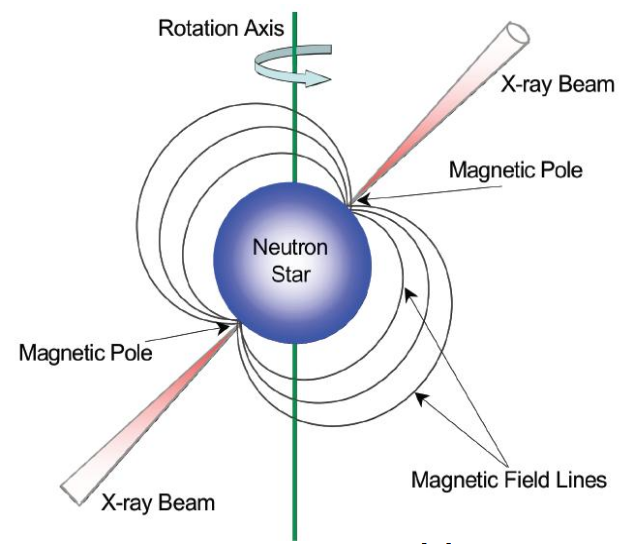
Pulsar "Rotation" Model

By establishing a timing phase model of pulsars at the Solar System Barycenter (SSB), the arrival time of any pulse at the SSB can be predicted. Meanwhile, by on-orbit processing of photon measurement data, the arrival time of that pulse at the spacecraft can also be obtained. The difference between the measured time and the predicted time reflects the projection of the spacecraft's position relative to the SSB along the pulsar direction. By processing measurement information from different directions, the position and time of the spacecraft can be estimated. By comparing the pulsar bearing measurements with the pulsar direction vectors in inertial space, the attitude of the spacecraft body frame relative to the inertial frame can be determined.

As a type of celestial navigation, X-ray pulsar navigation shares the common features of celestial navigation: strong autonomy, strong anti-interference capability, high reliability, simultaneous positioning and attitude determination, and navigation errors that do not accumulate over time. In addition, X-ray pulsar navigation has unique advantages, mainly reflected in the following aspects:

(1) Providing high-precision reference time standards. The rotational period of X-ray pulsars is highly stable. For some millisecond pulsars, if the observation period exceeds 8 years, the long-term stability can reach the order of 10−1510^{-15}10−15 [5]. Using pulsar observation information, one can maintain the spacecraft navigation system time by establishing an integrated pulsar time, and simultaneously calibrate the onboard atomic clock bias while determining the spacecraft position.

(2) High navigation accuracy. Traditional celestial navigation methods determine spacecraft positioning by measuring the spatial angle between reference celestial bodies and the spacecraft, and their accuracy depends on the distance from the spacecraft to the reference body. For deep space probes in the cruise phase, traditional celestial navigation methods can only achieve positioning accuracy of several thousand kilometers. However, under the same conditions, X-ray pulsar navigation accuracy can be better than ten kilometers.

Furthermore, compared with satellite navigation, X-ray pulsar navigation has the advantage of simultaneously serving both near-Earth spacecraft and deep space probes.

2 Research Progress on Pulsar Parameter Determination and Related Theory

Accurately determining the spatial distribution, radiation characteristics, and rotational period characteristics of X-ray pulsars is a prerequisite for conducting X-ray pulsar navigation research. The X-ray energy range emitted by pulsars is 0.1∼200 keV0.1\sim200\,\text{keV}0.1∼200keV (0.1∼20 keV0.1\sim20\,\text{keV}0.1∼20keV for soft X-rays, 20∼200 keV20\sim200\,\text{keV}20∼200keV for hard X-rays [6]). It is generally believed that soft X-rays are suitable for X-ray pulsar navigation. To make full use of existing ground-based and space-based observation resources, it is recommended to select pulsars that simultaneously emit radio signals (which can penetrate the atmosphere) and X-ray signals as navigation pulsars. Through ground-based radio observations, the spatial distribution and rotational period characteristics of pulsars can be determined; by launching spacecraft, the profile and phase information of pulsars in the X-ray band can be measured.

2.1 Discovery, Naming, and Classification of Pulsars

2.1.1 Discovery of Pulsars

In 1967, graduate student Jocelyn Bell at the University of Cambridge, while analyzing interplanetary scintillation observation data, accidentally discovered a series of periodic signals in a direction with no known radio sources, and reported the finding to her supervisor, Professor Antony Hewish. Bell and Hewish initially speculated that these periodic signals might be messages from extraterrestrial beings. However, the pulse signals received by the research group only contained frequency shifts due to Earth's orbital motion, with no motion information from the source itself. Therefore, the signal source was ultimately confirmed to be an extraterrestrial natural body. In 1968, Hewish and Bell published the discovery in Nature, naming the discovered celestial radio source a "pulsar" [7]. The discovery of pulsars was one of the four major astronomical discoveries of the 1960s, opening up a new astronomical research field and profoundly impacting modern astrophysics. In 1974, Professor Hewish was awarded the Nobel Prize in Physics for the discovery of pulsars.

2.1.2 Naming of Pulsars

Current pulsar names are expressed as "PSR reference_epoch pulsar_RA pulsar_Dec", where north declination is denoted by "+++" and south declination by "−-−", with declination significant digits at 0.1∘0.1^\circ0.1∘ or 0.01∘0.01^\circ0.01∘. Therefore, the first pulsar discovered by Bell is named PSR 1919+16\text{PSR}~1919+16PSR 1919+16. Additionally, in some globular clusters where discovered pulsars have nearly identical positions, making them hard to distinguish by position alone, a letter is appended after the coordinates for differentiation. Similar to the position calibration of stars, the right ascension and declination of pulsars also need to account for the reference epoch. Older catalogs mostly use the Besselian year beginning as the epoch, denoted by BBB (e.g., epoch B 1900.0B~1900.0B 1900.0, B 1950.0B~1950.0B 1950.0, etc.). The International Astronomical Union (IAU) stipulated that from 198419841984 onward, catalogs should uniformly use the Julian year beginning as the epoch, denoted by JJJ. The current standard is epoch J 2000.0J~2000.0J 2000.0. For pulsars discovered before 199319931993, both epochs can be used, distinguished by BBB and JJJ respectively. Pulsars discovered after 199319931993 use only epoch JJJ.


To be improved...

References

[1] Wang Yidi. Research on X-ray Pulsar Signal Processing and Navigation Methods [D]. Changsha: National University of Defense Technology, 2016.

[2] Li Li. Research on Autonomous Navigation Methods for Spacecraft Based on X-ray Pulsars [D]. Changsha: National University of Defense Technology, 2007.

[3] Manchester R N, Hobbs G B, Teoh A, et al. The Australia telescope national facility pulsar catalogue [J]. Astronomical Journal, 2005, 129(4): 1993-2006.

[4] Zhu Cisheng. Astronomy Tutorial [M]. Beijing: Higher Education Press, 2003.

[5] Kaspi V M, Taylor J H, Ryba M F. High-precision timing of millisecond pulsars. III. Long-term monitoring of PSRs B1855+09 and B1937+21 [J]. Astrophysical Journal, 1994, 428: 713.

[6] Wang Shouxuan, Zhou Youyuan. X-ray Astrophysics [M]. Beijing: Science Press, 1999.

[7] Hewish A, Bell S J, Pilkington J D H, et al. Observation of a rapidly pulsating radio source [J]. Nature, 1968, 217(5130): 709-713.

Improve this page
Last Updated: 4/29/26, 11:30 AM
Contributors: ouyangjiahong, Hermes Agent, Cron Job
Prev
Trajectory Planning
Next
/en/glossary/navigation/autonomous-navigation/
地月空间入门指南
Cislunar Space Beginner's GuideYour guide to cislunar space
View on GitHub

Navigate

  • Home
  • About
  • Space News
  • Glossary

Content

  • Cislunar Orbits
  • Research
  • Resources
  • Blue Team

English

  • Home
  • About
  • Space News
  • Glossary

Follow Us

© 2026 Cislunar Space Beginner's Guide  |  湘ICP备2026006405号-1
Related:智慧学习助手 UStudy航天任务工具箱 ATK
支持我
鼓励和赞赏我感谢您的支持