China Unifies Crewed Lunar and Robotic Moon Programs Under Single Lunar Exploration Project
Summary: On May 23, 2026, China's Manned Space Agency (CMSA) spokesperson Zhang Jingbo announced a major organizational restructuring: the country's crewed lunar landing program and the Chang'e robotic lunar exploration program will be merged into a single "Lunar Exploration Project," administered uniformly by the China Manned Space Agency. Chang'e-7 has already arrived at the Wenchang Space Launch Center for a H2 2026 launch, and China reaffirmed its goal of achieving its first crewed lunar landing by 2030.
A Unified Architecture: Two Programs Become One
Speaking at the Jiuquan Satellite Launch Center on May 23, Zhang Jingbo, spokesperson for China's crewed space program and Director-General of the Comprehensive Planning Bureau of the CMSA, announced that China's existing crewed lunar landing program and the Chang'e lunar exploration program would be integrated from three angles — mission design, resource allocation, and personnel management — and unified under the "Lunar Exploration Project" framework.
Previously, the crewed lunar landing program was managed by the CMSA while Chang'e was overseen by the China National Space Administration (CNSA). Zhang stated the integration would enable "unified planning, unified organization, and unified execution," fully leveraging decades of accumulated technical expertise and avoiding redundant development.
Chang'e-7: Arrived at Wenchang, Launch Target H2 2026
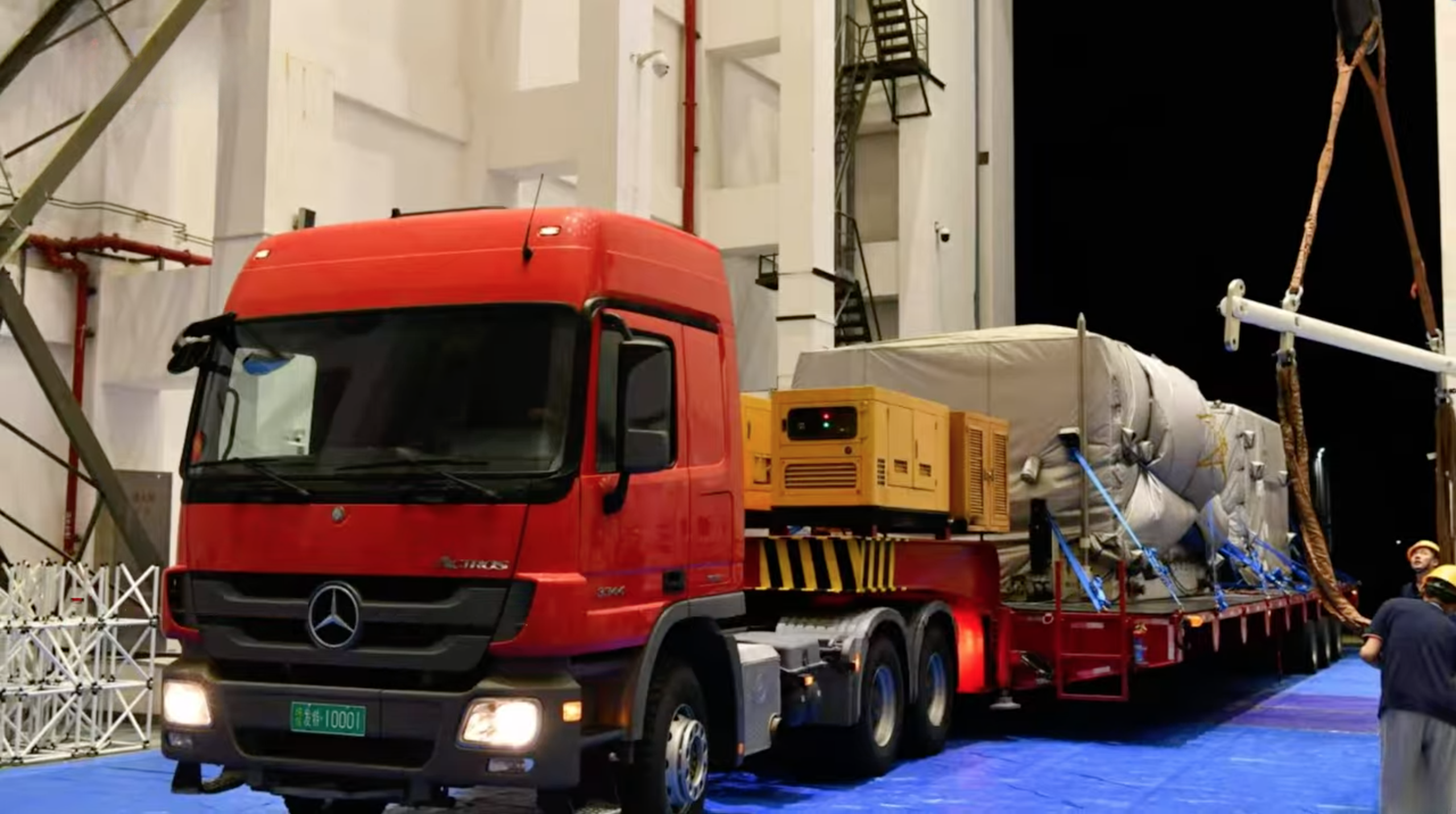
Zhang confirmed that the Chang'e-7 lunar probe arrived at the Wenchang Space Launch Center in Hainan in April 2026. Pre-launch testing is proceeding on schedule, with a launch window targeted for the second half of 2026.
The Chang'e-7 mission will employ a combination of orbiting, landing, roving, and lunar hopper techniques to survey the lunar south pole environment and resources, while carrying out international cooperation. The spacecraft will carry scientific instruments developed by Egypt, Bahrain, Italy, Russia, Switzerland, Thailand, and the International Lunar Observatory Association.
Long March 10, Mengzhou, Lanyue: Hardware on Track
Zhang outlined the development status of key crewed lunar hardware:
- Long March 10 carrier rocket: Completed tether ignition testing and low-altitude demonstration; successfully conducted low-altitude demonstration and Mengzhou spacecraft maximum dynamic pressure escape flight tests earlier in 2026; hardware has undergone reusability adaptations
- Mengzhou crewed spacecraft: Completed zero-altitude escape tests and multiple large-scale ground verifications; spacecraft and rocket use integrated design
- Lanyue lunar lander: Completed landing and ascent tests
- Wangyu EVA spacesuit: Under engineering development
Throughout 2026, multiple space station missions will conduct in-orbit verification of the above products, comprehensively improving technical maturity and mission reliability.
Tiangong Space Station: Talent Pool and Technology Testbed
Zhang emphasized that the Tiangong space station supports crewed lunar exploration in three major ways:
- Talent reserve: Space station missions have cultivated a team of astronauts with extensive spaceflight experience, forming a solid foundation for crewed lunar mission selection
- Key technology verification: The station verifies microgravity fluid management, radiation protection, and long-duration life support technologies critical to lunar missions; the Tianzhou-10 cargo mission carried a surface tension storage tank fluid sloshing experiment in microgravity, validating lunar lander technical specifications
- Integrated design: The Long March 10A rocket and Mengzhou spacecraft used for space station missions share integrated design and development engineering with the Long March 10 and Mengzhou lunar spacecraft required for the lunar landing mission
2030 Crewed Landing: Two Launches, One Orbital Docking, 6 Hours on the Moon
Under the plan, China's first crewed lunar landing will use a dual-launch architecture:
- Long March 10 (lunar version, three-core configuration, 5m core diameter, ~92m length, ~27t LEO payload) launches Mengzhou crew capsule and Lanyue lander separately
- The two vehicles dock in lunar orbit
- A crew of 2–3 astronauts lands on the Moon, staying approximately 6 hours for scientific exploration
"We will make every effort to strive for the goal of achieving the first Chinese landing on the Moon by 2030," Zhang stated.