China's Wukong Satellite Reveals Key Mechanism of Cosmic Ray Acceleration
Summary: On April 29, 2026, an international research team led by the Purple Mountain Observatory of the Chinese Academy of Sciences published a landmark discovery in Nature, using ten years of data from the Wukong dark matter particle detection satellite. The team found for the first time that the acceleration limit of cosmic rays depends on particle charge — revealing that nearby cosmic ray accelerators have a definitive upper limit for different charged particles. This finding is of great significance for understanding the origin of cosmic rays.
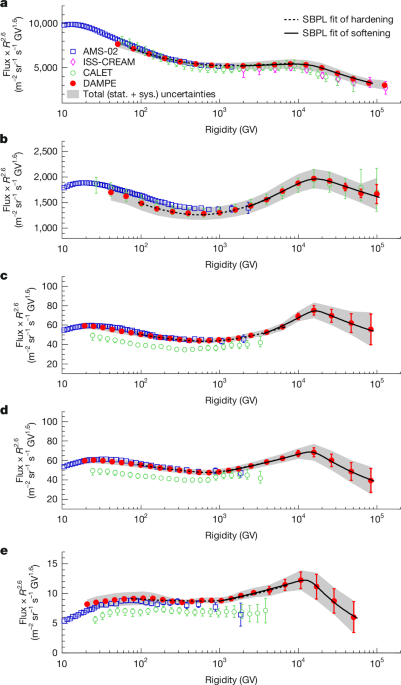 Credit: Purple Mountain Observatory / Nature
The Wukong dark matter particle detection satellite was launched on December 17, 2015, and has been operating smoothly in orbit for over 10 years, continuing to deliver exceptional scientific results beyond its original design life. The satellite carries 75,916 signal channels, making it China's most electronically complex satellite in orbit and the world's widest-energy-range space detector with the best energy resolution.
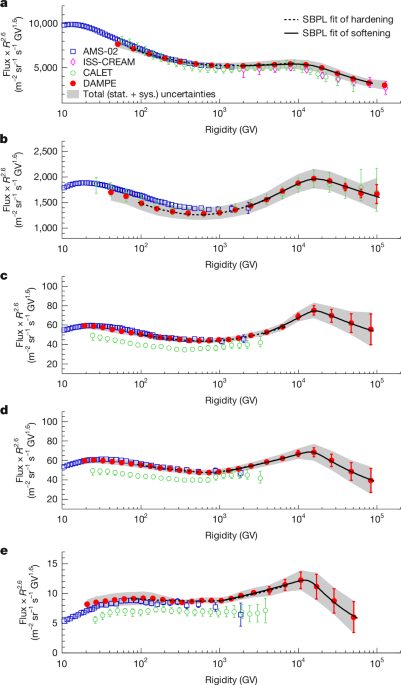
Using Wukong's powerful detection capabilities, the team precisely measured the energy distributions of the five most common cosmic ray particles — protons, helium, carbon, oxygen, and iron — and for the first time directly observed a consistent "bump" structure in their high-energy spectra. The maximum effective measurement energies for carbon, oxygen, and iron were improved by nearly 10 times compared to previous observations. Further analysis revealed that the position of this "bump" is directly proportional to the particle's charge.
Combining multiple observational datasets, the team concluded that there exists a nearby cosmic ray accelerator near Earth, and the "bump" in the energy spectrum marks the upper limit of that accelerator's capacity. This discovery provides new observational evidence for cosmic ray acceleration mechanisms and has profound implications for understanding the origin and propagation of cosmic rays.
Building on Wukong's success, the Purple Mountain Observatory, together with other Chinese institutions, has proposed the Very Large Area Gamma-ray Space Telescope (VLAST) — a next-generation gamma-ray detection project expected to achieve 10 times the performance of the current Fermi-LAT instrument, potentially opening new frontiers in dark matter research and cosmic ray studies.