
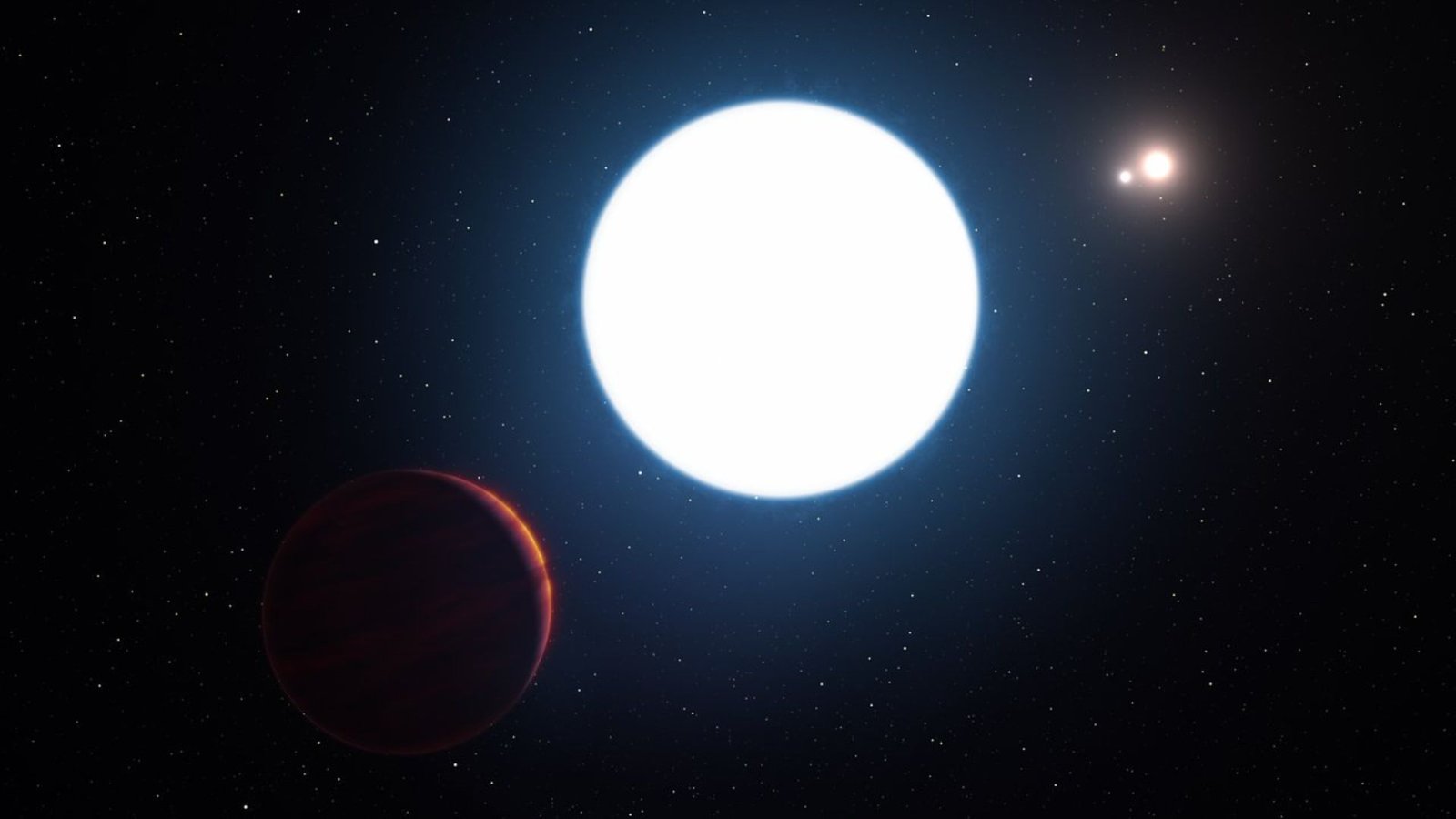
Summary: A team led by NASA Goddard researcher Brian Powell has confirmed a rare triple star system in data from NASA's Transiting Exoplanet Survey Satellite (TESS). TIC 295741342 hosts a sun-like binary orbited by a 1.7-solar-mass outer star, all three coplanar and aligned edge-on to Earth, allowing the outer star to sequentially eclipse both inner stars every 1.13 years.
System architecture
TIC 295741342 lies 3,080 light-years from Earth. Its core is a binary of two near-solar twins separated by 10.6 million km on a 4.75-day period; their masses were derived from radial-velocity measurements taken with the Tillinghast 1.5-m reflector at Whipple Observatory in Arizona. A 1.7-solar-mass third star orbits the pair every 412.8 days (about 1.13 years).
"Very few known triple star systems are so near-perfectly coplanar as TIC 295741342, especially for being such a wide system," Powell told Space.com. Coplanar means all three stars orbit in the same plane, much as the planets of the solar system share the ecliptic. Our planets cluster within about six degrees of the ecliptic because they condensed from a disk of gas and dust around the young Sun; the three stars of TIC 295741342 likely did the same.
A disk-fragmentation origin
"The protostellar disk broke into pieces to form stellar companions," Powell noted. Not every triple system forms this way — many have a third star whose orbit is tilted relative to the central binary, suggesting the outer star was gravitationally captured in the crowded birth cluster. Disk fragmentation itself is not rare: Kepler and TESS have together cataloged hundreds of coplanar triples, but TIC 295741342 is among the most thoroughly characterized.
The head-and-shoulders light curve
TESS records a first dip in brightness as the inner binary eclipses itself. About 1.13 years later, the outer star passes in front of each inner star in turn, producing a second, deeper dip. Powell describes the resulting light curve as having a "head-and-shoulders" shape. TESS's extended photometric baseline is what makes such slow, periodic outer-star eclipses detectable in the first place: a system needs years of monitoring to confirm a 412.8-day period.
Comparison with classic triple-eclipse systems
TIC 295741342's outer period is much wider than the canonical examples. Lambda Tauri, identified in 1956 as the first known eclipsing triple, has an outer period of just 30.5 days. TIC 290061484, found by TESS in 2024, has a 1.8-day inner binary and a 24.5-day outer period. The wide architecture of TIC 295741342 makes it a useful laboratory for studying disk-fragmentation outcomes and long-term hierarchical dynamics, where the influence of the outer star on the inner binary can be measured on a tractable timescale.