
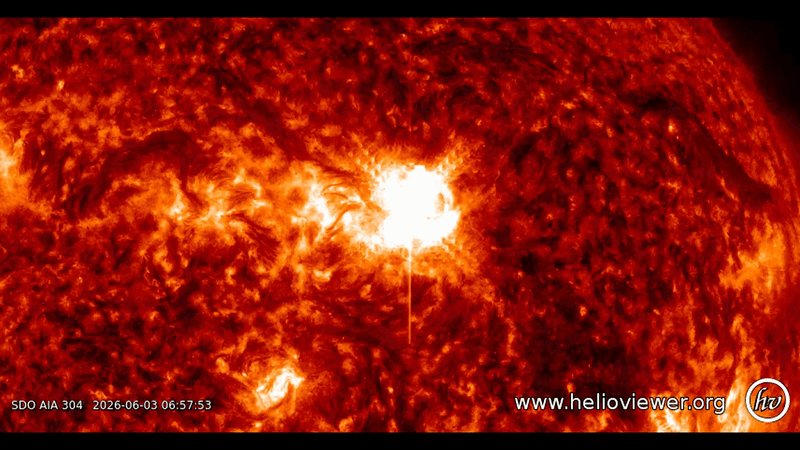
Sun Unleashes 3 Major Solar Flares in 24 Hours: M9.3, M7.9, X1 From Region 4455 Trigger G3 Geomagnetic Storm Watch
Summary: Between June 2 and 3 UTC, Earth-facing sunspot region AR4455 produced three significant solar flares in under 24 hours: an M9.3 peaking at 01:36 UTC June 3, an M7.9 at 07:00 UTC, and an X1.0 at 11:28 UTC, the strongest category of solar flare. The U.K. Met Office has confirmed the M9.3 flare was accompanied by a fast, Earth-directed coronal mass ejection (CME) expected to arrive June 4. NOAA's Space Weather Prediction Center has issued a strong (G3) geomagnetic storm watch for June 4-6, with a slight chance of isolated severe (G4) conditions. The trio of flares triggered R2-R3 radio blackouts across East Asia and North America.
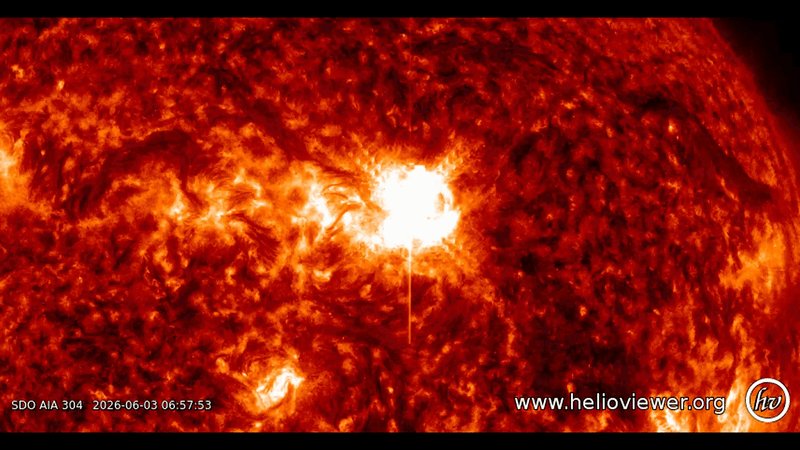
Three Flares in Less Than a Day
All three eruptions originated from the same Earth-facing active region, AR4455. Per Space.com's compilation of NOAA SWPC data, the timeline is:
- M9.3: peaked at 9:36 p.m. EDT June 2 (01:36 UTC June 3)
- M7.9: peaked at 3:00 a.m. EDT (07:00 UTC) June 3
- X1.0: peaked at 7:28 a.m. EDT (11:28 UTC) June 3, the strongest of the three and the first X-class flare of the sequence
Radio Blackouts and an Incoming Storm
The X1.0 flare triggered a strong R3 radio blackout, while the M9.3 and M7.9 flares each produced moderate R2 blackouts, affecting high-frequency (HF) communications across parts of East Asia and North America.
The M9.3 flare was accompanied by a faint but fast Earth-directed CME, which the U.K. Met Office has confirmed is expected to arrive at Earth on June 4. Whether the M7.9 flare spawned a second Earth-directed CME remains under analysis, and the trajectory of any CME linked to the X1.0 flare is still being determined.
Based on the confirmed CME path, NOAA SWPC has issued a G3 (strong) geomagnetic storm watch for June 4-6, with a slight chance of isolated G4 (severe) conditions if the incoming solar storms deliver a stronger-than-expected impact.
Aurora May Reach Mid-Latitudes
If the CMEs arrive as forecast, Earth's magnetosphere will be disturbed. Auroras are typically confined to high latitudes, but strong geomagnetic storms can push the visible range into mid-latitudes. NOAA and the U.K. Met Office both indicate that beginning the evening of Thursday June 4, auroras may be visible at lower latitudes than usual across several northern U.S. states and the U.K.
Region 4455 Still Active
Space weather physicist Tamitha Skov wrote on X following the M9.3 eruption: "Region 4455 strikes again! Region 4455 continues to grow in complexity, so X-flare risk will remain elevated over the next 72 hours at least." Aurora chaser Vincent Ledvina noted: "Three potentially Earth-directed CMEs are currently on the way," though exact trajectories and speeds are still being analyzed.
AR4455 is still evolving. Whether it produces another X-class flare in the coming days remains to be seen.