
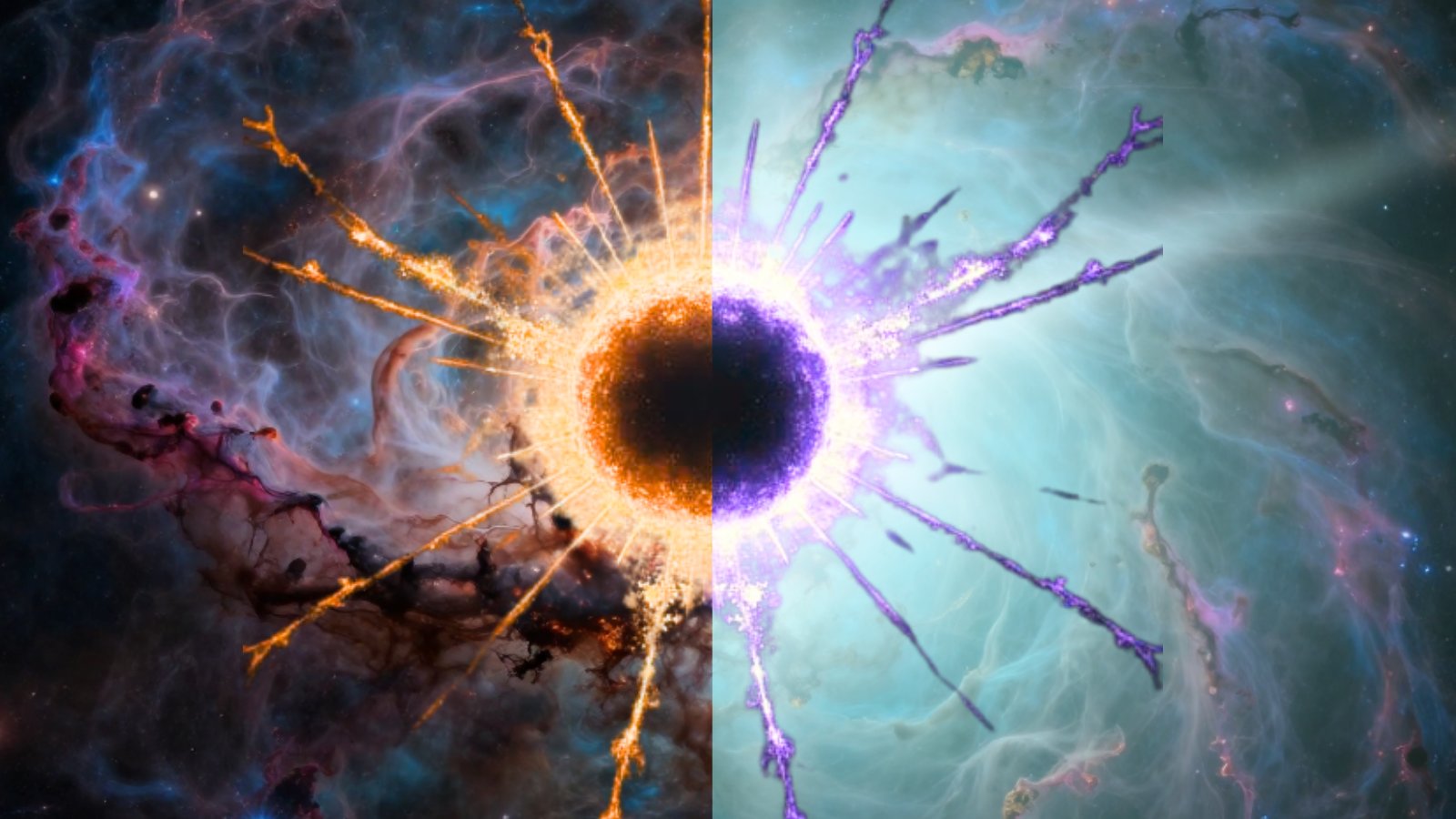
Summary: A research team at Penn State's Eberly College of Science, led by Daniel Paraizo, has recalculated the fate of primordial black holes (PBHs) under Hawking radiation using a semi-classical model. The team found that PBHs whose initial masses fall in a particular range do not simply "vanish" when they shrink to the Planck mass (~20 micrograms, roughly the weight of an eyebrow hair). Instead, they enter a stable end-state that, when observed from far away, is physically indistinguishable from a hypothetical white hole. A preprint of the work is available on arXiv.
Background: why primordial black holes
The black holes that astronomers have actually observed are the stellar-mass variety — formed when massive stars collapse — with masses ranging from a few to a few hundred times the mass of the Sun. Their Hawking radiation is so feeble that they would outlast the current age of the universe many times over.
But theory also predicts another class: primordial black holes (PBHs), which could have formed directly from density fluctuations in the hot, dense fireball moments after the Big Bang. PBHs could in principle have almost any mass, from far less than a metric ton to many billions of tons. Since the 1970s, Hawking's calculation has implied that the smallest PBHs would evaporate the fastest — a one-ton PBH would, in theory, essentially explode instantly.
The unresolved puzzle sits at the bottom of this process: the Hawking-radiation framework breaks down when a black hole shrinks to the Planck mass, roughly 20 micrograms — about as heavy as a human eyebrow hair or a flea egg. At that scale, both general relativity and quantum mechanics fail, and no one knows whether the remnant simply disappears, "bounces," or transforms into something else.
The Paraizo team's calculation
Paraizo and colleagues deliberately took a "minimal-assumption" route: they applied semi-classical physics — general relativity combined with quantum field theory at low energies — to describe everything outside the black hole, without trying to guess what happens at or inside the horizon.
The result: a PBH formed with a mass of about a billion tons would take roughly a billion years to radiate down to the Planck mass, while a one-ton PBH would do so almost instantaneously. Either way, once a PBH reaches the Planck mass it stops losing energy through thermal radiation and settles into a stable phase.
In an interview with Space.com, Paraizo explained:
"We found that the lifetime of black holes is much longer than previously thought. The phenomena that we identify are relevant for black holes possibly formed in the early universe. These objects have not been observed yet, but their search is a topic of intense interest as dark matter candidates."
"Simple physical assumptions about the physics far away from a black hole can tell us a lot about their lifetime and about their transition to a stable phase that looks like a 20-microgram white hole. The fact that we can infer these properties, using only minimal ingredients from quantum gravity, is remarkable."
The white-hole connection
A white hole is, in a sense, a black hole run backwards in time: instead of trapping matter and radiation, it endlessly pushes them outward. Like PBHs, white holes are theoretically permitted by the equations of general relativity, but have never been observed.
The key claim of the new work is that the "stable phase" reached by a PBH at the Planck scale is, from the perspective of a distant observer, identical in every measurable respect to a 20-microgram white hole.
Paraizo and colleagues are careful with the wording. They do not claim to have proven that the remnant is a white hole — doing so would require a complete theory of quantum gravity that explains the interior physics of a white hole. Their language is "a stable end-state with a white-hole appearance," not "the black hole turned into a white hole."
Predicting the ultimate fate of these Planck-mass remnants will require a theory that unifies general relativity and quantum mechanics — the long-sought "quantum gravity" — which has eluded physicists since the early twentieth century.
Publication
A pre-peer-reviewed version of the team's research is available on the arXiv repository. A peer-reviewed version is expected to appear in a journal.