
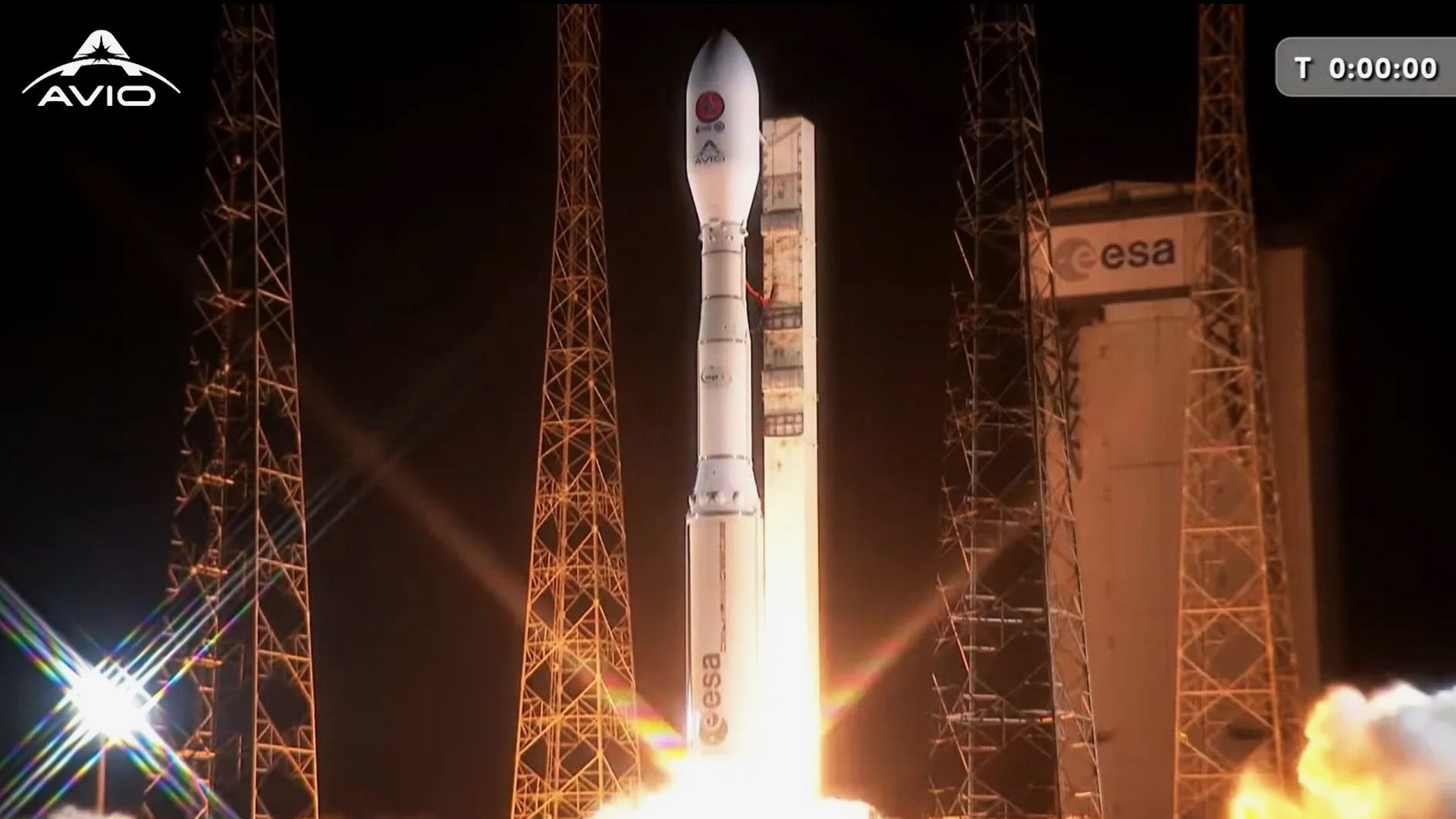
SMILE Satellite Successfully Launched: China-Europe Space Science Cooperation Takes Flight
Summary: At 03:52 UTC on May 19, 2026, the SMILE (Solar wind Magnetosphere Ionosphere Link Explorer) satellite — a joint mission between China and the European Space Agency — successfully launched aboard a Vega C rocket from Europe's Spaceport in French Guiana. The spacecraft achieved proper orbit, deployed its solar panels approximately two hours after liftoff, and its first signal was received by ESA's New Norcia ground station in Australia at 04:48 UTC. This marks China's first mission-level, comprehensive deep-cooperation space science mission with ESA.
Mission Overview
SMILE is designed to capture the world's first X-ray images of Earth's magnetosphere on a global scale, using an innovative soft X-ray imaging technology. The satellite carries four scientific payloads:
- Magnetometer (developed by Chinese Academy of Sciences)
- Low-Energy Ion Analyzer (developed by Chinese Academy of Sciences)
- Ultraviolet Aurora Imager (developed by Chinese Academy of Sciences)
- Soft X-ray Imager (developed by ESA)
Launch Timeline (UTC)
| Event | Time |
|---|---|
| Liftoff (00:52 local Kourou) | 03:52 UTC |
| Spacecraft separation | ~04:20 UTC |
| First signal received (New Norcia) | 04:48 UTC |
| Solar panel deployment | 04:49 UTC |
Scientific Significance
ESA Director General Josef Aschbacher stated: "We are about to witness something we've never seen before — Earth's invisible armour in action. With Smile, we are pushing the boundaries of science in an effort to answer big questions that have remained a mystery since we discovered, over seventy years ago, the phenomenon of geomagnetic storms."
The mission's scientific objectives include:
- Advancing understanding of solar wind-magnetosphere coupling mechanisms
- Revealing the causes of space weather events
- Improving space environment forecasting capabilities
ESA and China share a 25-year record of cooperation spanning from early data-sharing arrangements in the 1990s to this co-developed Smile mission.
Next Steps
The satellite has a design life of three years. After reaching its operational orbit and completing approximately two months of in-orbit testing and payload calibration, it will officially enter routine science observation phase. Chinese and European scientists will jointly conduct data processing, inversion, and scientific analysis, with data resources shared globally among research institutions.