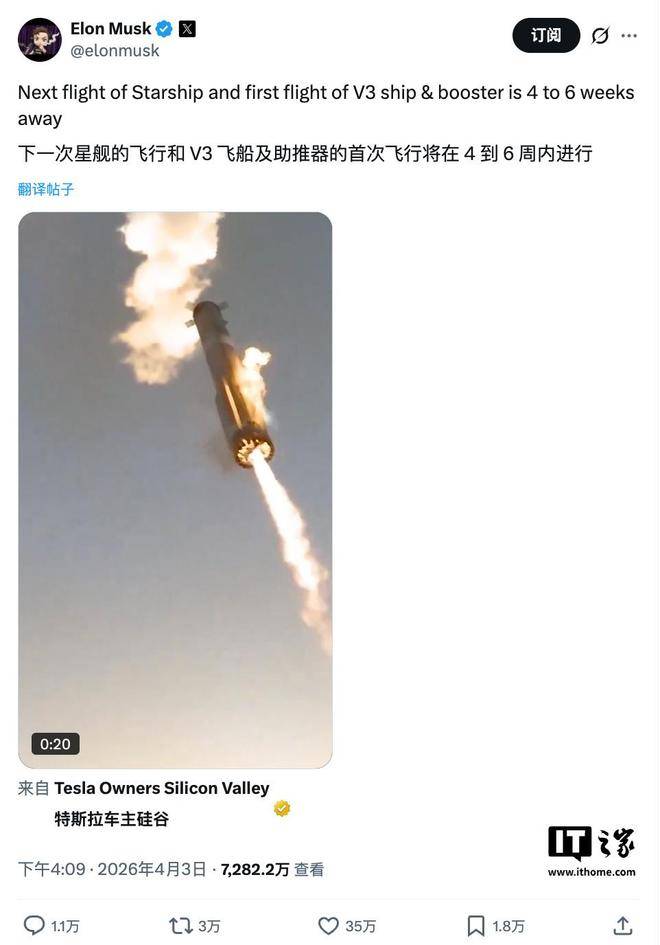
Elon Musk announced on X (April 3) that the Starship V3 first flight has been delayed another 4–6 weeks, pushing the target from April to early May. This marks the third consecutive delay: January's "6 weeks," March's "4 weeks," and now "4–6 more weeks."
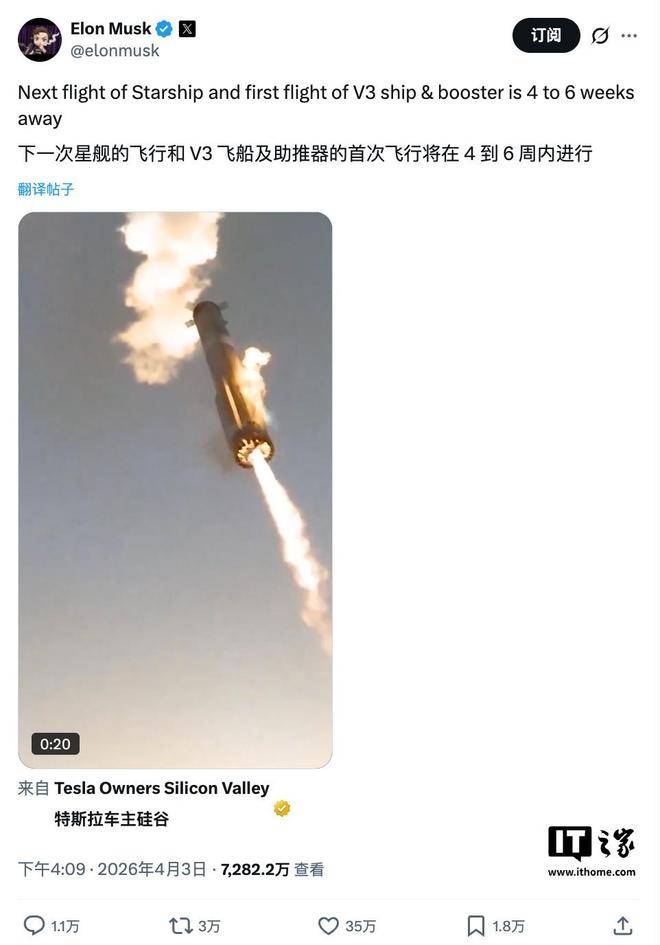
Credit: SpaceX
Major Upgrades in V3
Starship V3 incorporates dozens of technical upgrades over V2 aimed at improving reliability:
- Taller airframe — V3 stands approximately 5 feet (1.5 m) taller than V2
- Payload leap — LEO capacity jumps from V2's ~35 tons to approximately 100 tons, nearly a tripling
- Raptor V3 engines — Upgraded engines with significantly improved thrust and efficiency
- Docking adapter — New hardware enabling in-space propellant transfer, a critical capability for lunar missions
Context and Implications
The last Starship flight took place in October 2025, over six months ago. A NASA Office of Inspector General (OIG) report noted that a single crewed lunar landing may require 10+ Starship launches, including multiple in-orbit refueling operations — making V3's propellant transfer capability especially significant.
While the repeated delays have drawn scrutiny over schedule management, SpaceX has consistently prioritized flight reliability over schedule pressure. As a major iteration of the Starship family, V3's maiden flight performance will directly impact the timeline of NASA's Artemis lunar landing program.