China Achieves First Precise Thermal Conductivity Measurement of Single Lunar Soil Particles
Summary: A joint research team from the Technology and Engineering Center for Space Utilization (CAS), Tsinghua University, and the Institute of Geochemistry (CAS) has achieved the first precise measurement of single-particle thermal conductivity in Chang'e-5 lunar soil. The study reveals that agglutinate particles exhibit thermal conductivity as low as ~8 mW·m⁻¹·K⁻¹ under vacuum conditions — rivaling high-performance synthetic aerogels and representing the lowest thermal conductivity ever reported for a natural material.
 Credit: CNSA
Background and Particle Classification
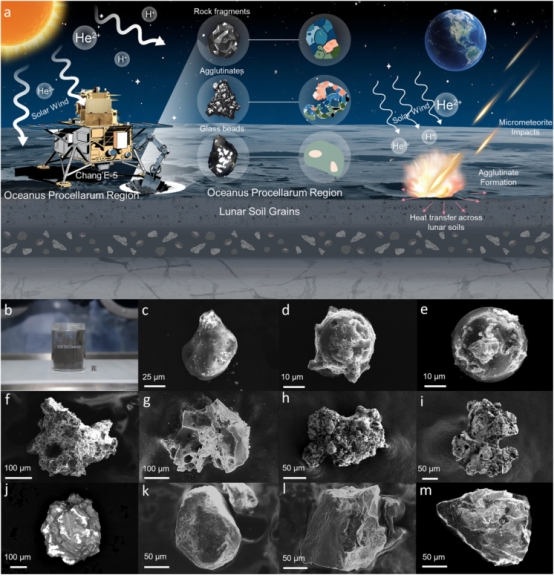
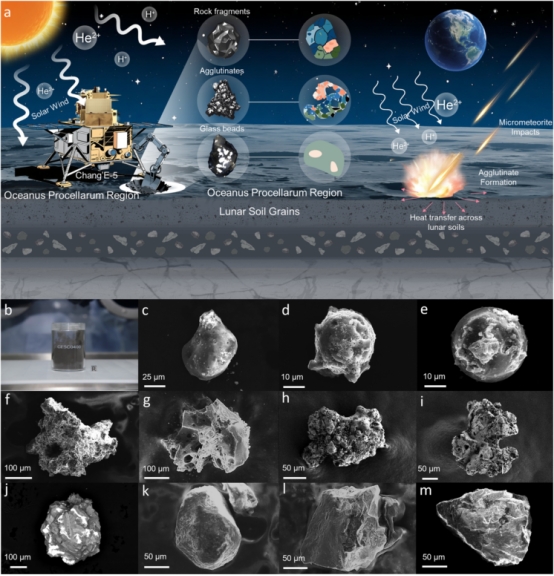
Lunar soil particles fall into three categories based on morphology: agglutinates, rock fragments, and glass beads. Agglutinates are products of lunar space weathering — their glassy matrix forms from impact melting and encapsulates mineral fragments (plagioclase, pyroxene, olivine). Rapid cooling traps gases, creating a hierarchical pore structure spanning nano- to micrometer scales.
Porosity varies dramatically: agglutinates ~17.78%, rock fragments ~4.02%, glass beads ~1.38%.
Key Results
The team used a custom-designed cantilever H-type micro/nano thermal bridge device in high vacuum to measure intrinsic thermal conductivity:
| Particle Type | Thermal Conductivity (253 K) | Comparison |
|---|---|---|
| Agglutinate | ~8 mW·m⁻¹·K⁻¹ | Baseline |
| Rock fragment | ~27–79 mW·m⁻¹·K⁻¹ | 3–5× agglutinate |
| Glass bead | ~120–490 mW·m⁻¹·K⁻¹ | 1–2 orders higher |
Agglutinates are the most thermally insulating component in lunar soil, with conductivity reduced to ~12% of ideal dense crystalline minerals.
Physical Mechanism
The ultra-low thermal conductivity of agglutinates stems from their multi-scale structure:
- Amorphous molten glass binding diverse mineral fragments limits phonon mean free path
- Nano-to-micrometer hierarchical pore networks enhance phonon scattering and interfacial thermal resistance
- Multi-phase interfaces (plagioclase, olivine, etc. with glass phase) exhibit significant vibrational mismatch, with interfacial thermal resistance up to 1000× that of ideal crystal-crystal interfaces
Applications
- Lunar surface thermal modeling: Reliable material properties for lander and in-situ equipment thermal design
- In-situ resource utilization: Thermal behavior prediction for lunar soil manufacturing and volatile extraction
- Novel materials: The multi-scale structure of lunar agglutinates provides a natural template for developing new extreme-environment insulation materials