Chang'e-4 Data Reveals 'Cosmic Ray Cavity' in Cislunar Space
Summary: A research team led by Prof. Shi Quanqi at Shandong University has discovered a spatial region of significantly reduced galactic cosmic ray (GCR) flux near the Moon's orbit — a "cosmic ray cavity" — using over three years of continuous data from the Lunar Lander Neutron Dosimetry instrument aboard China's Chang'e-4 lander. The structure results from Earth's magnetic field modulating GCR propagation paths, demonstrating that Earth's magnetospheric influence extends far beyond what was previously understood, reaching lunar orbit and beyond.
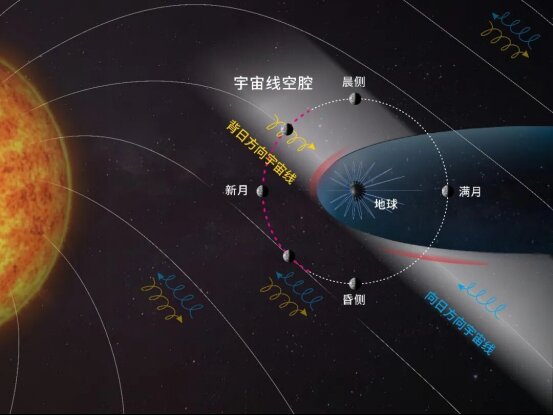 Credit: CNSA
Key Finding
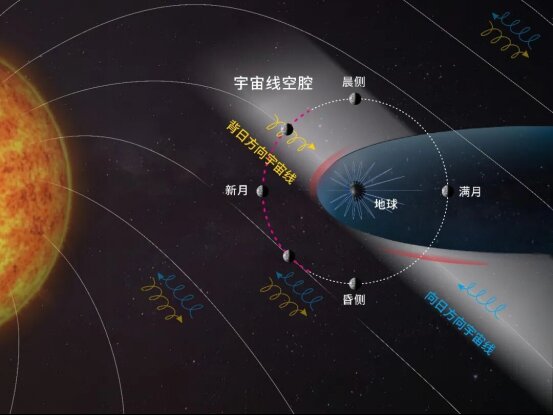
It has long been assumed that GCRs are approximately uniformly distributed in cislunar space, far from planetary magnetic fields. However, the team found that under stable interplanetary magnetic field and solar wind conditions, the lower energy band (9.18–34.14 MeV) GCR count rate drops significantly in the orbital segment before lunar phase 12 hM (new Moon position), forming a stable low-flux spatial structure.
The existence of this cavity was independently cross-verified using data from NASA's Lunar Reconnaissance Orbiter (LRO).
Formation Mechanism
Three-dimensional particle trajectory simulations show that Earth's magnetic field can significantly alter the propagation paths of GCR particles, creating a stable low-particle-density region in specific areas of cislunar space. Metaphorically, Earth's magnetic field acts like a boulder in a stream, deflecting cosmic ray particle flows traveling along the interplanetary magnetic field and forming a "cavity" on the downstream side.
Significance
- Radiation protection: The cavity may provide even stronger shielding for heavy ions (which have smaller gyroradii and are more easily deflected), potentially reducing the most hazardous radiation component
- Trajectory optimization: Similar cosmic ray cavities may exist around other strongly magnetized planets, informing interplanetary mission planning
- Paradigm shift: First evidence that Earth's magnetic field can modulate energetic particle distribution at cislunar space scales beyond the magnetosphere